
STOP THE SECRET SUBURBANIZATION OF THE TOWN OF NORTH EAST
Residents were told nothing was changing. The record shows otherwise. This investigation tracks the zoning rewrite, SEQRA filings, FEAF statements, and the hidden impacts on rural character and property rights.
THIS IS NOT A BLOG. THIS IS AN INVESTIGATION.
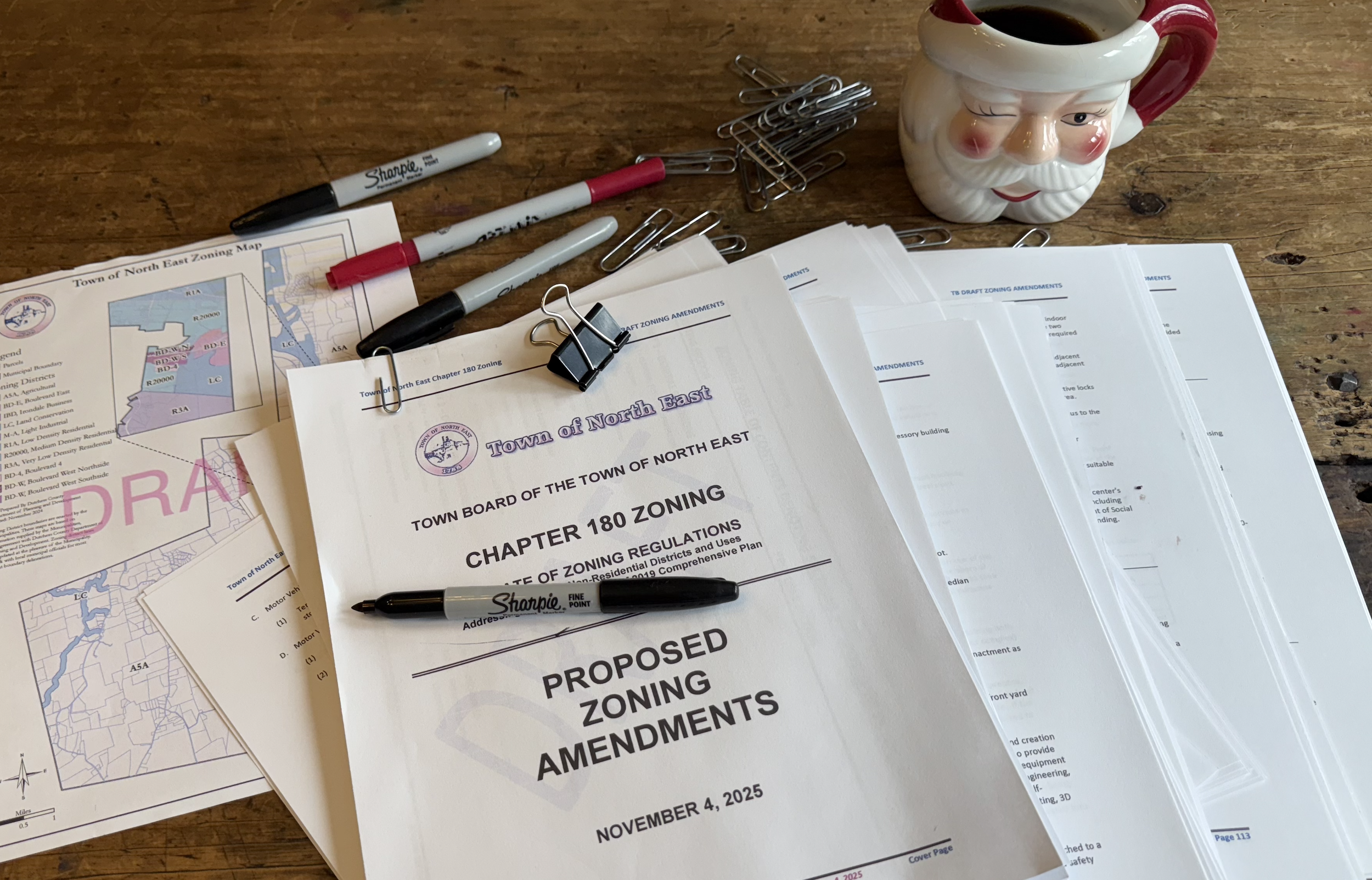
The week before Thanksgiving, the Town quietly posted a 181-page zoning overhaul on its website.
Just some minor tweaks — nothing to see. No summary. No explanation of scale. No explanation of future implications.
Just 181-pages of legal jargon meant to get the public to look the other way while they are too busy to do anything other than SURVIVE THE HOLIDAY CRUSH.
Just a friendly municipal document — enormous, technical, and dropped into the busiest and most distracted moment of the year.
And while the Town can say it was “disclosed,” disclosure only matters when people understand what they’re looking at. And yes — it was “disclosed.”
“Disclosed” in the way a magician reveals a trick: technically visible and STRATEGICALLY INVISIBLE.
A zoning rewrite of this magnitude deserved plain, understandable language, public sessions, diagrams, explanations, and time. Unless, that is, public understanding was not the goal.
Residents were told it was “primarily nonresidential.”
That is an actual LIE. Inside the document, almost every part of the Town’s land-use framework was being rewritten.
We are not here to exaggerate.
We are here because the gap between what was said and what is actually written is too large to ignore.
The new code includes:
36,000-sq-ft mixed-use buildings
35,000-sq-ft grocery stores
12,000-sq-ft commercial pads
Large-scale buildouts for parcels 10 acres and up
Town-wide Accessory Dwelling Units
Revisions to how lot area is calculated
Entirely new use tables and dimensional standards
All of this may be “disclosed” in the technical sense. But none of it was presented in a way that allowed the public to understand the implications for water, traffic, rural character, taxes, or long-term development pressure.
The same applies to the sewer district. Residents have known about it for years — but few were aware of how closely its footprint aligns with the new large-scale zoning allowances, or how little it reflects the federal guidelines meant to protect residential neighborhoods from subsidizing commercial expansion.
This is not the public’s fault. It is a symptom of how information has been communicated.
This site was created because residents deserve clarity, not fine print; context, not fragments; and honest framing, not the quiet posting of major decisions without explanation.
From now until January 8, we will be walking through every major change:
What the new zoning actually permits
What the Town’s notices and statements said
What is being increased, redefined, or newly allowed
What wasn’t emphasized
What is standard practice — and what isn’t
How development pressure, infrastructure, and local character interact
And how residents can evaluate these changes with full information
Our goal is understanding.
We are taking the documents, maps, tables, public minutes, timelines, and state standards — and explaining them with the transparency and plain language that should have been provided from the start.
This is not a town of bystanders. This is a town that reads, questions, and shows up for itself.
If you’ve ever thought, “I don’t know what any of this means, but I wish someone would just explain it,” this is that explanation.
And it’s only the beginning